Christ Alone
As soon as sin entered the world through Adam and Eve's rebellion, God met them in the garden. And even in that moment of sorrow and judgment, He proclaimed the first promise of the gospel by speaking to the serpent and foretelling the coming Savior who would one day crush the enemy's head: “I will put enmity between you and the woman, and between your offspring and her offspring; he shall bruise your head, and you shall bruise his heel” (Genesis 3:15, ESV).
READ DEVOTIONAL
Grace Alone
As we approach our celebration of Reformation Day, we are exploring the five "solas," Latin phrases that summarize what the Reformation recovered about the Christian faith. We have considered sola scriptura, Scripture alone as our final authority, and sola fide, faith alone as the means by which we are made right with God. Now we come to sola gratia: grace alone. Grace means undeserved favor. It is God giving what we could never earn.
READ DEVOTIONAL
Faith Alone
Last week we began our journey toward Reformation Day by considering sola Scriptura: the conviction that Scripture alone is our final authority for what we believe and how we live. That conviction is not an end in itself. It is a means. Once we determine that the Bible alone governs the church, the next question naturally follows: what does the Bible actually say about how a sinner is made right with God?
READ DEVOTIONAL
Scripture Alone
The doctrine of Scripture alone begins with a problem. Notice the question: “Who can understand it?” The prophet's rhetorical question confronts us with a difficult reality: we cannot. That truth can be uncomfortable because the heart is the very instrument we use to evaluate nearly everything else. Yet Scripture tells us that the instrument itself is unreliable. I have never met anyone who naturally assumes, “I am probably mistaken in the way I feel about matters.” The human heart does not arrive with hesitation or self-doubt. It arrives confident, convinced, and almost always certain that it is right.
READ DEVOTIONAL
When I Am Weak
If I asked you to name a Bible verse cross-stitched onto a pillow, printed on a gym water bottle, or tattooed on the bicep of a professional athlete, I suspect today’s verse would likely come to mind for many of us. It has become something of a spiritual multivitamin — swallowed before job interviews, athletic competitions, and final exams, as though Paul had penned a promise of unlimited human potential.
READ DEVOTIONAL
The God Who Waters the Earth
Psalm 65:9–13 reminds us that every season of labor and rest unfolds under God’s sovereign care. This devotion traces that truth through David’s song of praise and Ruth’s story of redemption, showing how the Lord provides for both the weary and the anxious. Whether tending fields or navigating daily work, we are invited to release our grasp on outcomes and rest in the One who waters the earth, strengthens the faint, and crowns each year with His goodness.
READ DEVOTIONAL
Betrothed to the Bridegroom
Picture yourself among the Twelve, walking dusty roads with a Rabbi who spoke often in pictures drawn from ordinary life. You would have grown up watching the weddings of your village in the hill country of Galilee, though as a child you did not understand what you were watching. You would have known that a betrothal was not like a modern engagement, easily broken over supper. When a man and woman were betrothed, a contract was drawn, a price was often paid to the father, and from that moment the two were considered legally bound—husband and wife in the eyes of the law, though the marriage was not yet consummated. To break a betrothal required a certificate of divorce, the same as ending a marriage. You would have heard the elders explain this once, when rumors swirled about Mary before Jesus was born—how betrothal carried the full weight of covenant, even before the wedding feast.
READ DEVOTIONAL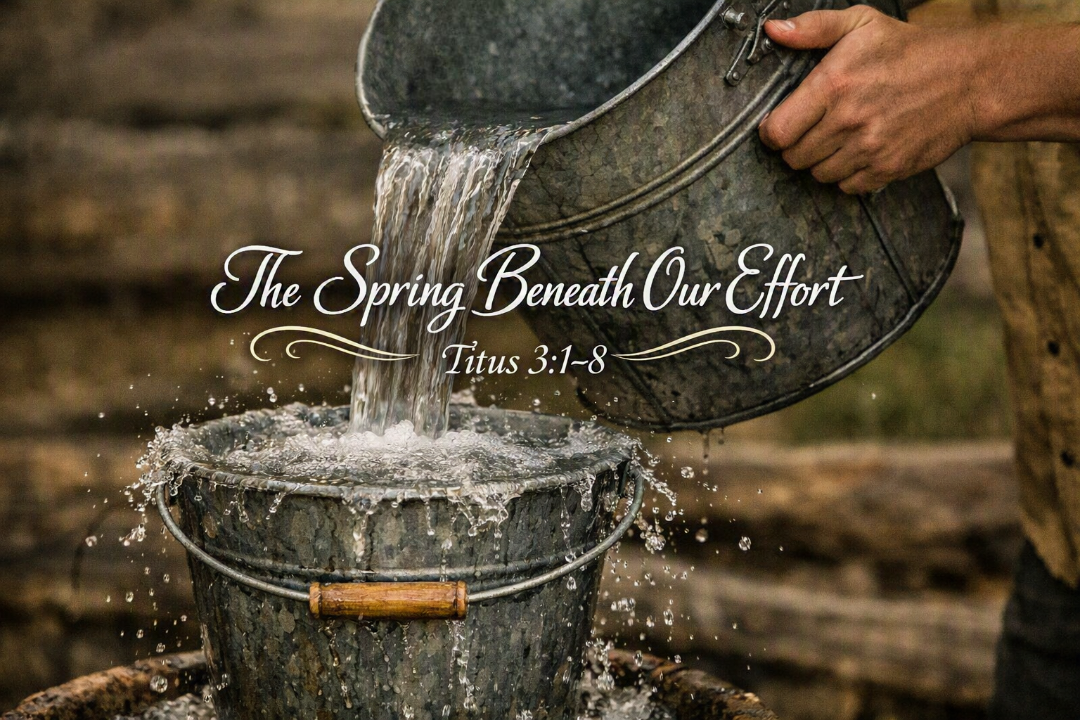
The Spring Beneath Our Effort
Picture an old well on a farm during a long drought. The bucket still hangs on its rope. The crank still turns. But when you lower that bucket down and pull it back up, it comes back empty—or worse, full of mud and dust. The problem is never with the bucket. The problem is with the source of the well. Somewhere down below, the water table itself has dropped and the well has dried up. And until the spring is replenished, no amount of cranking, effort, or technique is going to produce water.
READ DEVOTIONAL
The Subsequent Glories
This devotion explores Peter’s phrase “the sufferings of Christ and the subsequent glories” by setting Daniel’s sealed, bewildering visions alongside the apostles’ unveiled proclamation, showing that what the prophets longed to understand has now been openly announced in the gospel. Daniel’s experience by the Tigris—faithful, prayer‑worn, and yet unable to grasp the revelation given to him—becomes a lens through which Peter explains that the Spirit of Christ was pointing them toward a suffering Messiah and the glories that would follow, glories they knew were not for themselves but for a future people. Paul declares that this once‑hidden mystery has been revealed in Christ, not awaiting some future decoding but fully disclosed to the church. The devotion invites believers to stand in the wonder of that unveiled grace, rejoicing with inexpressible, glory‑filled joy that the very realities prophets searched for and angels long to behold are now ours in Christ, calling us to live as people who already possess the glories secured by His suffering and resurrection.
READ DEVOTIONAL
My Lord and My God
Refusing to build his hope on rumor, Thomas demands to see the wounds—and Jesus meets him there, offering not rebuke but invitation. When Thomas touches the scars, his response is not a startled exclamation but a deliberate, theologically loaded confession: “My Lord and my God.” John places this moment at the climax of his Gospel to show that the crucified and risen Jesus is truly the God of Israel, worthy of worship. The early church defended this truth, the Scriptures proclaim it, and believers today stand with Thomas whenever they confess Christ’s deity. His story reminds us that faith is not the absence of questions but the act of bringing them to the wounded Savior who still invites us to believe.
READ DEVOTIONAL
Inheriting Grace
Ephesians 6:1–4 offers a compact yet profound theology of the family, showing how life “in the Lord” reshapes both the obedience of children and the responsibility of parents. Paul anchors the household in Christ, calling children to honor their parents as part of God’s enduring moral order, and urging fathers to reject both permissiveness and harshness in favor of Christ‑like discipline and instruction. This devotional reflects on the generational consequences of neglecting God’s design, the hope found in repentance and grace, and the reminder that wisdom—unlike possessions—cannot be inherited automatically but must be given, received, and lived. Whether raising young children or seeking reconciliation with grown ones, believers are invited to return again to the grace that meets failing parents and wandering children alike, in the Lord.
READ DEVOTIONAL
The Greater Prophet
As I sat with Luke’s account of Jesus at the gate of Nain, I was struck again by how deliberately Scripture prepares us for this moment. Israel had seen prophets raise the dead before—Elijah pleading over the widow’s son, Elisha laboring in prayer over the Shunammite’s child—but never had they seen what happens here. When Jesus meets a grieving widow who has lost her only son, He doesn’t stretch Himself out, cry to heaven, or attempt the miracle in stages. He simply speaks, and death yields. In this week’s devotion, I want to walk with you through these three stories and see how they reveal the heart of our Savior—the Greater Prophet whose compassion moves Him toward the broken and whose authority over life and death belongs to Him alone.
READ DEVOTIONAL
The Bread of Life
In a small, easily overlooked offering of flour, oil, salt, and fire, God embedded a breathtaking preview of Christ Himself. This week we step into the temple courts, watching a priest lift an unleavened grain offering toward the altar — a shadow pointing to the sinless Son, anointed by the Spirit, tested through fire, broken for us, and given as our true daily bread. As the fragrance rises, Scripture’s unity comes alive: Leviticus and the Gospels speaking with one voice, revealing one Savior. Come see how this ancient ritual invites us to clear away the leaven, draw near to Christ, and feed on the Bread of Life who sustains us still.
READ DEVOTIONAL
Creation Declares
I’m writing this week from our campsite in Crescent City, where the Pacific’s roar is impossible to ignore. Standing at the shoreline, watching waves thunder and wildlife rise and fall in the swells, I was reminded that creation is constantly declaring the power and presence of its Maker. Romans 1 says God’s nature is plainly seen in what He has made, and Job 38 shows us those depths belong entirely to Him. This devotion is an invitation to slow down, notice, and let creation lead you into awe-filled worship of the God who commands the sea and calls us His own.
READ DEVOTIONAL
Like a Thief in the Night
On an ordinary night, when everything feels calm and predictable, we’re reminded that Christ’s return won’t wait for our readiness or our schedules. In Like a Thief in the Night, we examine how that truth unsettles us—not with fear, but with grace. It’s a call to wakefulness, to live alert and faithful even in the quiet hours. As we picture the stillness of a midnight house, we’re invited to ask: if He came tonight, would He find us awake, watching, and ready?
READ DEVOTIONAL
Accused
When the accusing voice rises—after failure, comparison, or distraction—it can feel like a courtroom where your conscience never rests its case. "Accused" invites you to step into that courtroom with Paul’s words from Romans 8:1–2 and hear the verdict that silences every charge. This devotion calls weary hearts to stop building "resumes of righteousness" for acceptance and instead rest in the mercy that has already declared them free.
READ DEVOTIONAL
Faithful Devotion
This week’s devotion, “Faithful Devotion,” draws us into the quiet, deliberate rhythm of spiritual leadership within the home. From Job’s early‑morning intercession to Joshua’s resolute declaration and David’s enduring legacy through Solomon, Scripture paints a picture of fathers—and all believers—who intentionally shape their households by the Word of God. In a world eager to disciple our families through its own curriculum, this devotion calls us to rise early, lead faithfully, and invest in a legacy that outlasts us.
READ DEVOTIONAL
Christ Exalted
In a world divided by theology and politics, this devotion calls us back to the center of every promise—Jesus Himself. Drawing from Galatians 3, Colossians 1, and Ezekiel’s vision, we're reminded that all God’s covenants find their fulfillment not in nations or movements, but in the One who reigns with perfect righteousness. Whether we wrestle with prophecy or ponder promise, our unity and hope are found in Him alone—the rightful Heir, the Redeemer, and the everlasting King.
READ DEVOTIONAL
Set the Scales Aside
Set the Scales Aside invites readers to lay down the instinct to measure worth, fairness, and forgiveness by human standards. In a world obsessed with keeping score, this reflection turns our gaze to the God who balances justice with mercy — who calls us not to weigh others’ faults but to remember the grace that tipped the scales in our favor. As you read, consider where you might still be holding the scales and how Christ’s mercy frees you to set them aside.
READ DEVOTIONAL