My Lord and My God
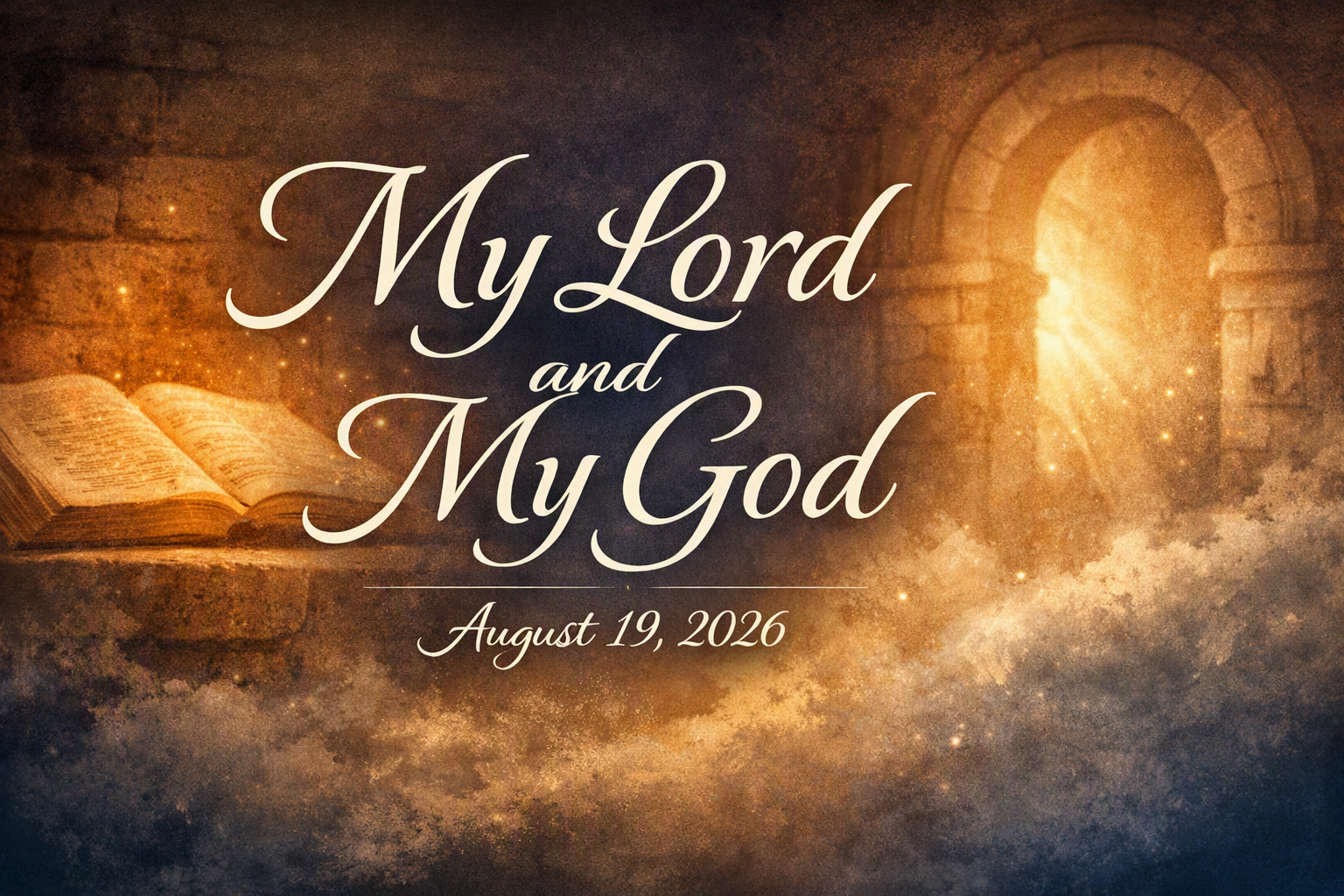
John 20:25-29 ESV
So the other disciples told him, “We have seen the Lord.” But he said to them, “Unless I see in his hands the mark of the nails, and place my finger into the mark of the nails, and place my hand into his side, I will never believe.”
Eight days later, his disciples were inside again, and Thomas was with them. Although the doors were locked, Jesus came and stood among them and said, “Peace be with you.”
Then he said to Thomas, “Put your finger here, and see my hands; and put out your hand, and place it in my side. Do not disbelieve, but believe.”
Thomas answered him, “My Lord and my God!”
Jesus said to him, “Have you believed because you have seen me? Blessed are those who have not seen and yet have believed.”
We know him as "Doubting Thomas," though I suspect that nickname has done him something of a disservice over the centuries. The grounds for Thomas’ skepticism are not known: was he a cynic looking for reasons to disbelieve? More likely, it was far simpler and far more human. Thomas was a grieving disciple who had just watched his rabbi and Messiah suffer and die on a cross, and he was not about to trust secondhand rumor nor even his own eyes. After all, John records Thomas physically verifying the risen Lord’s wounds plainly, and still some have attempted to undermine the reality of Christ’s bodily resurrection.
I confess a certain sympathy for Thomas. He’s often defamed by commentators but there could be something admirably honest about his demand. He does not want an account from the mouths of sinful men; he wants the risen Christ himself. And so, a week later, he gets exactly that. Jesus appears, and invites Thomas to do precisely what he said he needed to do, and Thomas's response is not merely relief, and it is not merely astonishment. It is a confession—one of the most theologically loaded sentences in the entire New Testament: "My Lord and my God!"
That raises the question this devotional wants to press on us this morning. Is that just the overflow of an emotional moment—a startled exclamation, the ancient equivalent of "Praise God!" torn from a man in shock? Or is Thomas doing something far more deliberate: making a doctrinal confession about who Jesus actually is? I want to suggest to you that the grammar, the theology, and the whole shape of John's Gospel all point in one direction—and it is not the direction of mere sentiment.
Perhaps you have stood exactly where Thomas stood. Not in a locked room in Jerusalem, but in a season of loss, or doubt, or plain exhaustion, wondering whether the resurrection is a comfort you can actually build your life on, or only a story you want to be true. Thomas's honesty is an invitation, not a rebuke: bring your doubts to Christ. Do not silence them, and do not settle for a faith that has never wrestled with the evidence. The Gospel of John was written for people exactly like Thomas—and exactly like us.
Exegesis: "My Lord and My God"
Look carefully at what Thomas actually says in John 20:28: "Thomas answered him, 'My Lord and my God!'" In the Greek, it reads “ho Kurios mou kai ho Theos mou”—"the Lord of me and the God of me." Notice first that this is addressed directly to Jesus. John does not tell us that Thomas cried out to heaven in astonishment; he tells us Thomas "answered him"—Jesus is the direct object of both titles.
Second, notice the words themselves are not casual. Kurios and Theos are the very terms the Greek Old Testament, the Septuagint, uses to translate the covenant name of God—YHWH. When a first-century Jewish man like Thomas—a man steeped in the Shema, in "Hear, O Israel: the LORD our God, the LORD is one" (Deuteronomy 6:4)—applies both of those titles to the man standing in front of him, he is not being loose with his language. He is doing the most theologically precise thing a monotheistic Jew could possibly do: he is identifying Jesus of Nazareth as God of Israel.
And Jesus does not correct him. Throughout Scripture, whenever a creature attempts to receive worship or divine honor that belongs to God alone, that honor is refused—think of the angel in Revelation 19 who tells John, "You must not do that! I am a fellow servant with you… Worship God." If Thomas's confession were mistaken idolatry, we would expect Jesus to do the same: to deflect, to correct, to redirect worship to the Father. Instead, Jesus receives it and then pronounces a blessing on all who will believe without having Thomas's advantage of sight: "Blessed are those who have not seen and yet have believed" (John 20:29).
This is no accident of narrative placement, either. It is the full climax of John’s case he has been constructing through his Gospel. His very first sentence was: "In the beginning was the Word, and the Word was with God, and the Word was God" (John 1:1). Thomas's confession in the final chapter is the bookend to that opening claim. The whole Gospel is arranged so that it begins with the assertion that the Word is God and ends with a witness falling at his feet and saying so. John even tells us his purpose in writing: "these are written so that you may believe that Jesus is the Christ, the Son of God" (John 20:31)—coming right on the heels of Thomas's confession, not by coincidence.
This is not a lone data point in the New Testament, either. Paul will later write that God has highly exalted Jesus so that "at the name of Jesus every knee should bow… and every tongue confess that Jesus Christ is Lord" (Philippians 2:10–11)—language lifted directly from Isaiah's declaration that every knee will bow to YHWH alone (Isaiah 45:23). Thomas's confession, in other words, is not an isolated outburst in a single Gospel. It is the first thread of a conviction that runs through the whole New Testament witness.
The Church's Confession, Then
Thomas was not the last person the church would need to convince of this. Within a few centuries, the doctrine Thomas confessed with his hands still trembling from touching the wounds would once again be debated in the halls of church councils, contested by early heresies that wanted to make Jesus something less than fully God—a superior creature, perhaps, an exalted being, but not truly, eternally divine. The church's answer, hammered out at Nicaea in AD 325, has echoed in Christian worship ever since: Christ is "God from God, Light from Light, very God of very God, begotten, not made, of one substance with the Father." That is not new theology invented three centuries after Christ. That is the church, under pressure, saying in careful, tested language exactly what Thomas said in a single unguarded breath: “my Lord and my God.”
C. S. Lewis put the choice starkly in a way that still forces the issue on us today. A man who says the things Jesus said—claiming to forgive sins, claiming unity with the Father, receiving worship without rebuke—cannot simply be regarded as a great moral teacher. As Lewis wrote, such a man "would either be a lunatic… or else he would be the Devil of Hell. You must make your choice. Either this man was, and is, the Son of God, or else a madman or something worse." Lewis's famous trilemma—liar, lunatic, or Lord—is simply Thomas's dilemma dressed in twentieth-century clothes. Thomas had the wounds in front of him and could not escape the verdict. We have the testimony of the apostles, the witness of the church, and the Spirit-breathed Scriptures—and the same verdict is pressed on us.
The Confession Now
This verdict is not meant to stay in the realm of theory. If Jesus is Lord and God, then he has the right to your obedience, not merely your admiration. He has the right to be trusted with your atonement, your fear, your grief, your unresolved doubt—the very things that had gripped Thomas before he saw the wounds. Faith, in the end, is not the absence of Thomas's questions; it is bringing those questions honestly to Christ and letting him answer them, as he did for Thomas, in his own presence and his own wounds.
So, this is what I want to leave you with today. This is not a private, sentimental truth that each of us is free to feel our own way toward. It is a confession—first spoken by a skeptic with his hand still in the wound, then defended by the ancient church against those who would diminish Christ and now recited every time God's people gather and say together, "very God of very God." When you stand next to your brothers and sisters in worship and confess the words of that ancient creed, you are doing exactly what Thomas did: putting your hand, as it were, into the wounds of the risen Christ, and declaring with the whole church, across every century—my Lord and my God.
With love in Christ,
Pastor Chris
Nicene Creed
We believe in one God,
the Father almighty,
maker of heaven and earth,
of all things visible and invisible.
And in one Lord Jesus Christ,
the only Son of God,
begotten from the Father before all ages,
God from God,
Light from Light,
true God from true God,
begotten, not made;
of the same essence as the Father.
Through him all things were made.
For us and for our salvation
he came down from heaven;
he became incarnate by the Holy Spirit and the virgin Mary,
and was made human.
He was crucified for us under Pontius Pilate;
he suffered and was buried.
The third day he rose again, according to the Scriptures.
He ascended to heaven
and is seated at the right hand of the Father.
He will come again with glory
to judge the living and the dead.
His kingdom will never end.
And we believe in the Holy Spirit,
the Lord, the giver of life.
He proceeds from the Father and the Son,
and with the Father and the Son is worshiped and glorified.
He spoke through the prophets.
We believe in one holy catholic and apostolic church.
We affirm one baptism for the forgiveness of sins.
We look forward to the resurrection of the dead,
and to life in the world to come. Amen.
Subscribe to my email list
Subscribe to receive weekly devotions, theological reflections, and resources that deepen your walk with Christ.
Thank you for subscribing!
Have a great day!